Thursday, July 3, 2014

Plus Size Sales Have Risen $17.5 Billion Since 2013—Are Better Styling Options on the Horizon?

plus-sized sales

Despite plus-size apparel being so stunningly shunned by the fashion industry, sales have been on a steady rise over the last three years, proving that there might be more to this size 12 thing than designers are willing to acknowledge. On Monday The NPD Group released a market research study that showed progressive progress on plus-size market sales. Up an overall five percent, the category has generated $17.5 billion in the last year alone and is estimated to continue climbing. We’re not expecting to see a size 16 Fendi dress available anytime soon, but with improving markets come improved selection—meaning women over a size 12 won’t be limited to squeezing into a 10 or opting for the disastrous “women’s” selections available at most department stores.
plus-sized sales
Speaking as a woman who can squeeze into a size 10 on her best days and is muffin-topping a size 16 on her worst, an improved plus-size market can only be a good thing. Instead of looking for a general size large, which just sort of fits (and not necessarily well), women can find tailored pieces in styles that are actually fashionable—no more of this oversized, shapeless nonsense. “The plus-sized market segment is seeing light at the end of the tunnel after being hit particularly hard by the recession,” said Marshal Cohen, chief industry analyst of The NPD Group. “With that, retailers and designers are now viewing this area as a growth opportunity, and today there are indeed more plus-sized choices in stores.”

plus-sized salesThe only category dropping in the market was the 13-17 age group with an 11 percent decline. Ages 18-24 rose 27 percent over the last two years with $1.1 billion in sales, while the 25-34 age range grew only 11 percent. From ages 35-44 numbers stayed relatively stable, the 45-54 range grew by only eight percent and the 55-64 age group showed the most monetary growth with a nine percent increase and $4.2 billion in sales. The 65 and over age range was second in sales at $4 billion. While most of these sales have been generated by specialty stores and e-commerce, it reflects an expanding market that may soon mean saying good riddance to stretchy pants, baggy tunics and amorphous maxi dresses. 
Fashion Ladies' Essentials Sale: Cheap Designer M Handbags Designer Bags Sale Bag Wallet Sets Cheap Functional Luggage Travel Bags

Tuesday, July 1, 2014

Winona Ryder Lands Major Fashion Campaign


This morning, when reading about why Rag & Bone cast Winona Ryder in their fall campaign (!!), I wanted to disagree with one of the reasons Marcus Wainwright, Rag & Bone's managing partner, cited: He told WWD that Winona was chosen for her "beautiful, timeless quality," and I wanted to call BS, at least on part of that.

You see, I think the 42-year-old actress is a smart choice precisely because she is heavily associated with one time period, the '90s, thanks to Edward Scissorhands and Reality Bites and that whole relationship with Johnny Depp. And these days, when it's hard to click more than three links on the Internet without running into some sort of '90s nostalgia tribute, and denim skirts, shower sandals, and other '90s staples walk the runways and dominate the sidewalks, it's hard to imagine Rag & Bone and Wainwright weren't thinking about Winona's '90s throwback appeal when they cast her--at least somewhat.

See what attracts people here: Designer Bags 58% off Cheap Bags 2014 Hot Selling Cheap Luggage Bags

Tuesday, May 20, 2014

A Fashion Faux Pas: The High Price of Using Animals for Fashion

A parrot feather hat, a crocodile skin corset, boots made of elephant skin: Doni Sprague has it all in a warehouse of fashion.

“There’s really no bounds or limits in this business,” she said.

But Sprague didn't buy this stuff. This collection costs more than money, so the U.S. government seized it.

"It's greed in a lot of sense, that's what it boils down to," said Special Agent in Charge Steve Oberholtzer with the U.S. Fish and Wildlife Service.

Oberholtzer oversees the government's multi-million dollar collection of goods made out of wild animals that people have been caught bringing into the United States illegally. And he says fashion drives much of what they see coming through the door.

"There's a wide variety of animals that have perfectly legal commercialization,” he said. “But there's also a lot of illegal commercialization in endangered and threatened species, so those are the ones that really need protection."

Which is why Fish and Wildlife agents seized elephant-tail bracelets from tourists, a reticulated python purse from a celebrity and a runway gown trimmed with caiman, which is a cousin to the crocodile.

Then there’s the trunk full of scarves, each made from Tibetan antelope, and which take five to seven animals to make. Each scarf costs up to $10,000.

He showed how agents can tell it’s Tibetan antelope: by running the scarf through his wedding ring. Only Tibetan antelope is fine enough not to bunch up and get stuck.

The News 4 I-Team analyzed a government database of all the fashion items people tried to sneak into the country in the last five years. Fish and Wildlife intercepted more than 9,800 illegal shipments worth in excess of $20 million.

Python, alligator, crocodile and caiman make up 48 percent, almost half, of all those shipments.

Sprague said, “If people would start looking at alternatives like simulated leathers, which are very good, instead of using genuine skin from a live animal, we could make a huge difference."

In the collection, Sprague has boots made of nearly every animal imaginable. As she showed off one pair, she said, “I kind of see a giraffe type of pattern but when you feel this, this is actually made of sting ray."

It’s all housed in a warehouse called the National Wildlife Property Repository.

Some of what’s in the warehouse comes from tourists who don't know the rules. A lot of it comes from companies who didn't get the right permits.

Then there are the people who tried to smuggle it in, including the huge pile of white boxes stacked in a corner of the warehouse. Each box contains one pair of boots made from the skin of the critically endangered Hawksbill sea turtle.

"It requires one turtle to make a single pair," Sprague said.

And it takes dozens of endangered cats to make a coat. "On average, a mid-length coat might contain fifteen to twenty cats just to create a single garment," she said.

“To the eye they can be very beautiful," Sprague said. "But you have to understand that beauty comes with a price, and in this case part of the price is the depletion of a species."

Read More # Fashion News Blog

Monday, April 28, 2014

Fashion world still wild about the wrap dress

The wrap dress is a seemingly simple silhouette on the surface, yet it’s enduringly fashion forward, figure flattering and forgiving! It’s been around for decades (or even centuries, depending upon whom you ask) and has become synonymous with Belgium-born New York-based designer Diane von Furstenberg, who popularized it with her take on the wrap introduced 40 years ago.

The fabled frock is front-and-center once again. It’s the subject of the exhibit “Journey of a Dress” that closes Thursday in Los Angeles and features vintage and contemporary designs by Ms. von Furstenberg, along with portraits of her by Andy Warhol, Barbara Kruger, Chuck Close, Francesco Clemente, Helmut Newton and Annie Leibovitz. It also includes stills of the wrap dress on the silver screen, adorning Cybill Shepherd in “Taxi Driver” and Amy Adams in “American Hustle.”

The DVF wrap dress also commemorated its birthday with a glitzy “wrapsody”-themed runway show at Mercedes-Benz Fashion Week in New York in February and a limited-edition collection of “Pop Wrap” dresses inspired by Warhol with bright colors and bold prints (available at www.dvf.com). The public was invited to take part in the celebration by sharing their stories and photos about job interviews, first dates and other memorable moments when they wore the dress of the hour.

“It is really all about the woman,” Ms. von Furstenberg said in an email interview with the Post-Gazette. “When it is on the hanger, it looks like nothing, but when a woman slips into it, something incredible happens. That is what has kept it relevant for all of these years.”

Ms. von Furstenberg was in her 20s when she debuted it. Prior to that she had made wrap tops reminiscent of the coverup wrap sweaters commonly worn by ballerinas and paired them with matching wrap skirts.

“I saw them together and thought, ‘Why not make it into a dress?’ So that is what I did,” she said. “It was really revolutionary at the time. Other designers were making these elaborate dresses. Everything was so complicated. I just set out to design an easy little dress that I could throw into a suitcase and wear anywhere, and it turned out to be exactly what women wanted at that time.”

She unveiled it at a period when “all the stars were in alignment,” in terms of women’s fashion wants, its fabrication, varying lengths and eye-catching prints, said Kathlin Argiro, an adjunct professor at the Fashion Institute of Technology in New York and a fashion designer with her own label since 1997. “It’s the ultimate dress, hands down.”

In the new book “The Lost Art of Dress: The Women Who Once Made America Stylish” ($28.99; Basic Books), author Linda Przybyszewski said part of the DVF wrap dress’ initial appeal was as an alternative to pantsuits. It was easy to wear and wash and sensual, thanks to the V-neck and the tie wrap.

It was a hit from the start, Ms. von Furstenberg said, adding that fashion editor and columnist Diana Vreeland “loved them.”

“I knew that was a good sign.”

A spot on the cover of Newsweek further legitimized the look.

“So many women wore that dress that I would count them walking up and down Park Avenue,” she said. “I was a European princess living the American dream.”

Trendy Fashion: Cheap Designer Bags Replica PRADA Bags Replica Michael Kors Bags Michael Kors Wallets Cheap

But the wrap dress’s roots go back more than 40 years. Some could argue that they can be traced to ancient Egypt, said Michael Gainey, an adjunct professor for The Art Institute of Pittsburgh’s fashion programs. Pretty much anything in fashion can be linked back to earlier eras, Ms. Argiro said.

Many fashion historians credit early interpretations of the wrap dress (then called a popover dress) to American designer Claire McCardell in the 1930s and ’40s. This look was based upon wrap-style designs by Italian designer Elsa Schiaparelli. Another iteration that predates these is the 1920s taxi dress by Charles James, who’s the subject of an exhibit opening May 8 at the Metropolitan Museum of Art in New York.

Ms. von Furstenberg drew inspiration for print and color for her wrap dress from Emilio Pucci, she said, and its sense of “effortlessness and playing to a woman’s body was informed by Halston.”

Designers past and present adding their own twist to the wrap helps keep the dress relevant and caters to varying tastes and needs. For instance, Ms. Argiro added wrap dresses to her collection because she felt there was a need for ones that provided more coverage up top. The dresses have done well, she said, and have prompted her to launch an e-commerce site to sell them.

Ms. von Furstenberg continues to come up with new ways to wear the wrap, from romper renditions to long and flirty ones.

“With the wrap dress, anything can happen,” she said.

Monday, April 21, 2014

The Creative Class | Penny Martin, Editor


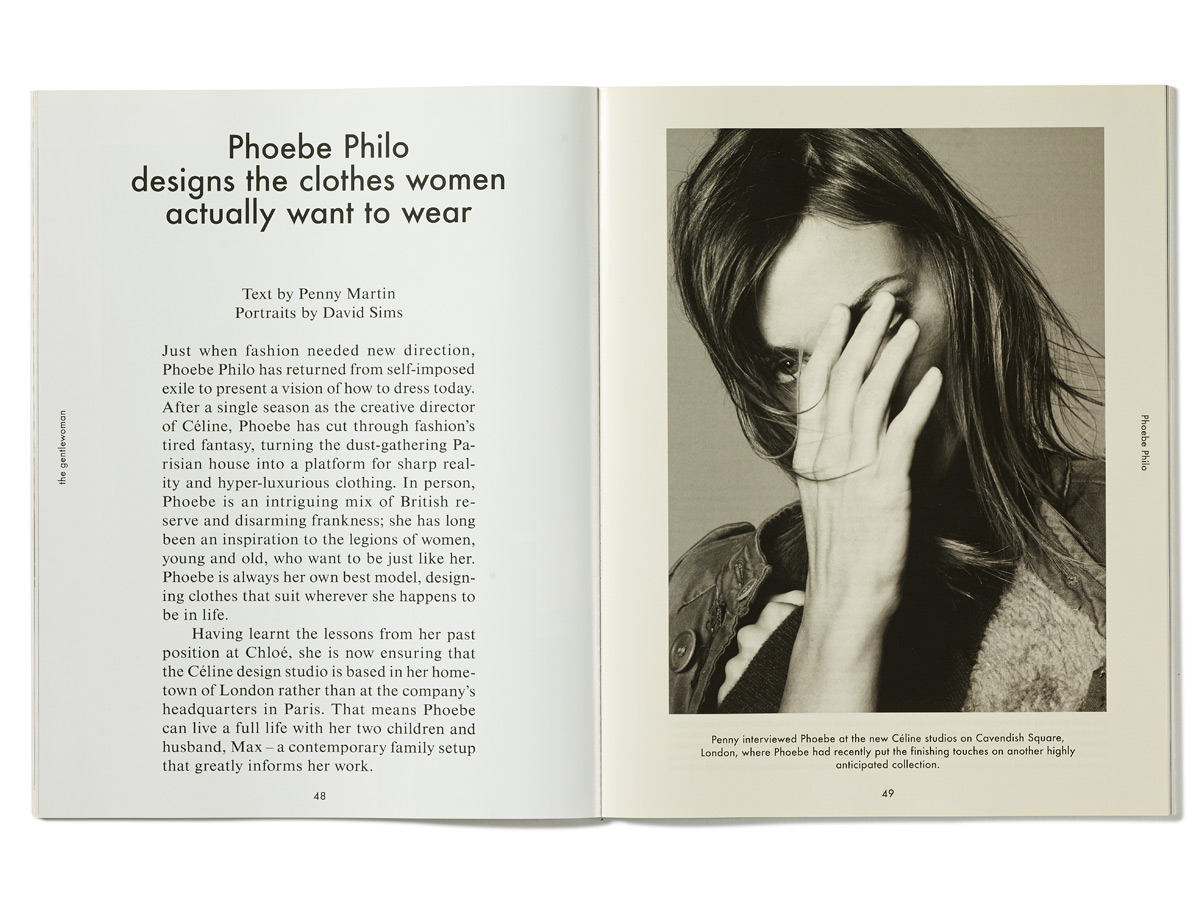
Launched in 2010 and known for its combination of glamour, pragmatism, modernity and warmth, The Gentlewoman now has nine issues under its belt. BoF sits down with editor-in-chief Penny Martin to discuss her role, the magazine’s DNA, and why the future is not about social media.

A trace of the academic is palpable in Penny Martin, editor-in-chief of The Gentlewoman. Her past as chair of fashion imagery at the University of the Arts, London, and years spent studying for a PhD (her unfinished thesis was on British Vogue and Thatcherism in the 1980s) is apparent in the way she responds to questions. “Could you qualify that?” she asks several times, carefully considering the implications of what has been posed.
Indeed, in a fashion media landscape rife with hype and hyperbole, there is no flippancy in the way Martin describes what she does at The Gentlewoman, which was launched in 2010 as a biannual sister publication to Gert Jonkers and Jop van Bennekom’s Fantastic Man and “celebrates modern women of style and purpose.”
“The future is about in-person transactions and real conversations rather than a cabaret of the nameless.”
“At that time, we felt there was a dearth of intelligent perspectives on fashion and there wasn’t really a fashion magazine for actual readers. I guess you could say that there are a few more magazines like us now. But when we started, many magazines had the visual right, or had the text right, but very few managed to reconcile the two. I think that’s very difficult — to produce long-form journalism and a personality-centred magazine that has equally eloquent imagery and graphic design.”
At Martin’s first meeting to discuss the creation of The Gentlewoman with Jonkers, Van Bennekom and art director Veronica Ditting, the team had just three sheets of visual references. “It just kind of took all four of us to look at them — a cover from Town and a spread from Bauhaus and a strange curio. We didn’t need to say anything more.”
With an early sense of visual direction, Martin and her team began formulating what the magazine would say: “We started by building up a common aesthetic. Quite Modernist. You might say it had parity with what was happening with Céline at the time. Coincidentally or not. We launched at the same time as [The Gentlewoman's first cover star Phoebe Philo’s] first collection [for Céline] arrived in stores.”
“To a large extent, we were also interested in that wardrobe-based approach to dressing that Fantastic Man had been excelling at for five or so years — that sartorial fascination with dressing rather than trend-led fashion. We explored that ‘good taste’ territory quite exhaustively as a sort of positioning statement for the first two or three years.”
But if there was one critique that was lobbed at The Gentlewoman’s early issues (the magazine has published nine issues so far) it was the tyranny of its own good taste, which might have grown suffocating, had the magazine not evolved its approach and “let a little bit of razzle in,” as Martin puts it. “In the last three issues, we’ve started to build up the fashion section and make it more coherent and less dispersed throughout the magazine. A bit more outspoken: maybe we’re a bit livelier, even a bit sexier.” Before The Gentlewoman, Martin had never edited a magazine before, though she was editor-in-chief of Nick Knight’s pioneering fashion website Showstudio from 2001 to 2008.
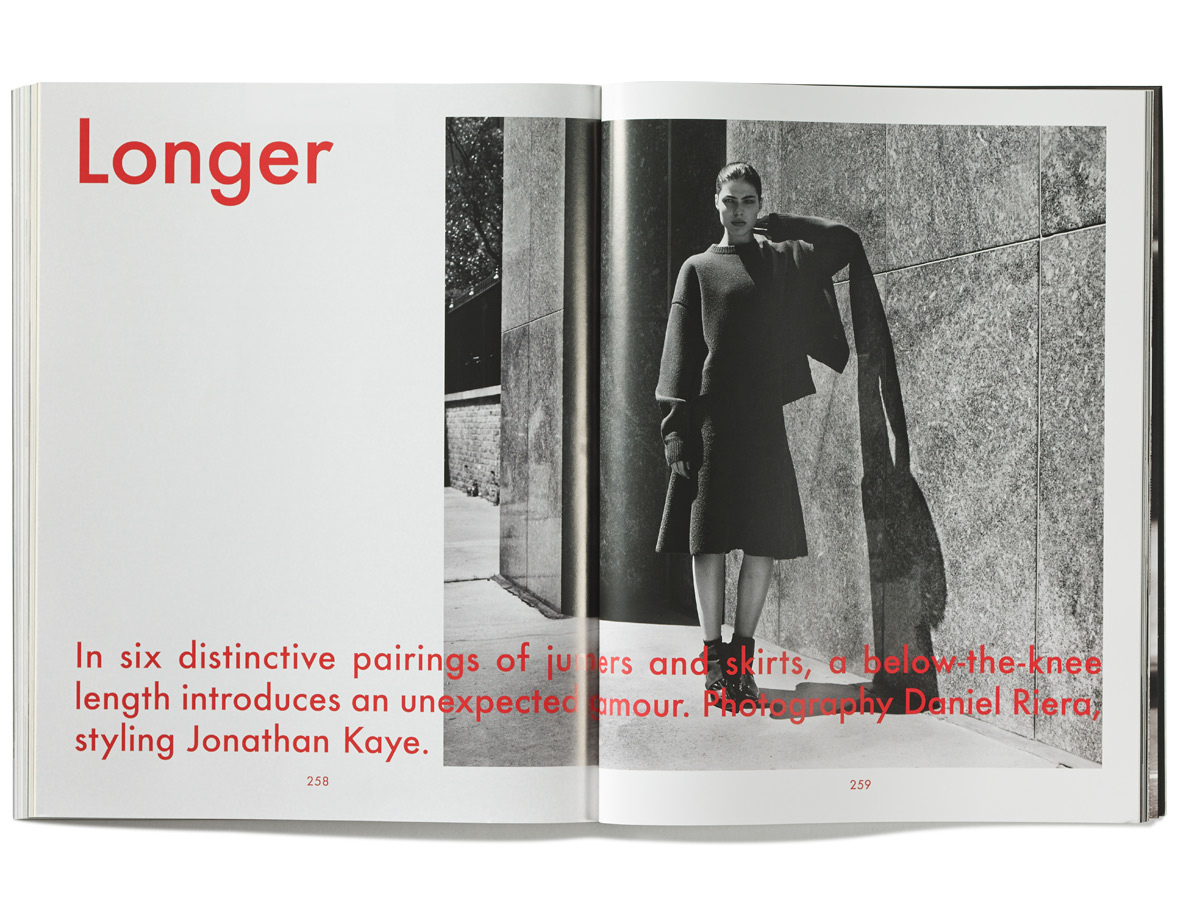
Key to developing the magazine’s visual sensibility was fashion director Jonathan Kaye, says Martin. “What Jonathan Kaye is very good at, I think, is creating solutions — things so seductive yet pragmatic that you can’t believe you hadn’t thought of them before. For the woman who feels overwhelmed with choice, he’s like a really good girlfriend who says, ‘Ok, calm down, so you do a sweatshirt and a second-hand trouser with a kitten-heel pump and that’s your solution.’ But, of course, it’s not just any sweater and trouser. He’s fastidious and it’s the one [look] that’s going to get you through without any embarrassing fuss. I think that’s the least patronising way to speak to grown, clever women about clothes. For last autumn, he did three-quarter-length skirts with a boot and a fuzzy jumper. It’s ‘Ok, here’s three things, that will work.’ There’s something extremely friendly, while still being directional [about his approach] that I love.”
A fashion story from the eighth issue of The Gentlewoman | Source: The Gentlewoman
Source: The Gentlewoman
This practical and modern approach is reflected in The Gentlewoman’s overall editorial point of view, which, according to Martin, begins with the woman and not the product. “I’m interested in what [The Gentlewoman] tells you about how modern women live, from the way they drink, dance, drive and speak to the way they sign their letters or conduct their divorces. We make sure that the magazine is not just a pornography of product that is supposedly interesting to women. It’s about putting those women at the centre of the material world around them. That balance is important to us.”
Cover stars have ranged from 88-year-old actor Angela Lansbury, shot in a peach silk blouse and Terry Richardson’s black frame glasses, to mega-popstar Beyoncé, looking calm, strong and composed in Dior with a face free of make-up. Meanwhile, on the inside, The Gentlewoman has profiled a wide range of women at the top of their game, including gardeners, entrepreneurs, novelists, artists and news anchors.
Like many editors of women’s magazines, Martin is often asked about her publication’s stance on feminism. “When people ask me about politics or feminism, I say that it isn’t a magazine about those things, it’s a magazineinformed by those things — among others.”
“Is it a feminist magazine? Well, it’s made by feminist people, so what do you think?! But I don’t want to make those values and principles fashionable, because I don’t want to undermine them by turning them into an aesthetic and I don’t want them to pass into the realm of the unfashionable. Let’s just assume that we all agree there should be equal pay and childcare and get on with it, eh?”
The magazine is based in a Victorian townhouse around the corner from the British Museum in London’s Bloomsbury district, a neighborhood know for its literary connections (Martin lives and also has a home office in the calm quarters of Ealing in West London). The team consists of a skeleton crew of around five, though this number swells to around ten during production and does not include the magazine’s extensive network of satellite contributors. But the leanness of the core staff has its benefits, says Martin. “We’re not massive, but that means we can work decisively and quite fast. We don’t need to focus-group [test] anything — you know from seeing the whites of one another’s eyes how excited or panic-stricken everyone else is about an idea.”
“There’s a lot of excitement through the days and then we open another bottle of wine at 9pm to get through the next shift,” she continues. “It’s an extremely ambitious, challenging environment. One might think that when you’re approaching the tenth issue that you might be giving into comfort a bit and tending to your consultancies, but that’s not what the environment is here. I work really long hours and I don’t have much of a boundary between personal space and work space, because this is what I would have done as a hobby if I’d had the chance, quite frankly.”
Small through the team may be, The Gentlewoman has generated highly respectable results for an independent title. “We were quite cocky in printing as many [copies] as Fantastic Man when we first launched, which was 72,000 in 2010 and they’d just had Ewan McGregor on the cover of their issue, which was a huge issue,” says Martin. “We thought ‘We’ll be lucky,’ but we actually sold out super-fast.”
The Gentlewoman printed 98,000 copies of the Beyoncé issue, which sold out and was re-ordered multiple times by the magazine’s distributor. “I know that our sell-through is amazing and that comparable magazines sell about a third of what they produce. We’re told there’s a strong case to come out more frequently. But we’re not convinced that’s necessarily the best allocation of our resources, when there are other things we could do or be.”
“Other things” includes the recently formed Gentlewoman Club which extends the magazine’s brand into physical events where readers can interact and chat with editors. “We’re starting to develop our website as a kind of portal for real things to happen rather than a bogus virtual community with likes and message boards. I am so not interested in that. I think that’s over.”
“For me, the future is going to be about in-person transactions and real conversations, skills and sharing in real spaces, rather than the cabaret of the nameless we’ve witnessed over the past decade.”

Saturday, April 19, 2014

Mulberry Cuts Prices While Burberry Raises Them

TWO of Britain's best-known labels have today unveiled different pricing strategies for the coming year, with Mulberry cutting prices and Burberry announcing that it may have to increase them.
Mulberry's pricing structure was reworked under recently departed CEO Bruno Guillon, to lift it above more affordable competitors - including Michael Kors - into the realm of catwalk labels like Prada and Balenciaga. The brand - which issued a second profit warning in three months today - will make the move knowing that the impact will be short-term, Reuters reports, but asserted that it is needed to assure the company's future financial strength.
Burberry, meanwhile, tempered an announcement of strong results in Asia with the warning that the strengthening pound may yet hurt sales. Burberry finance chief Carol Fairweather told The Times that there would be no "knee-jerk reactions" in terms of price changes, but that if rival retailers altered their prices, Burberry may follow - noting that unfavourable exchange rates could knock £30 million off its profits next year.
Sterling has risen around four per cent against the US dollar over the past six months.

Monday, April 7, 2014

Why Helena Never Became A Brand

HELENA CHRISTENSEN never put her name to merchandise and spin-off collections in the way that some of her fellow supermodels did - but the Danish model doesn't regret that decision for a minute.

"I never did it, and I probably lost out on a lot of deals because of that, but it just didn't feel right," Christensen admitted during an interview to promote her latest collaboration with Triumph which is proof, if anything, that anything she touched would have turned to gold. "I always thought, 'OK, you've got what you need, you've saved up what you could, so now you can work on things that inspire you.'"
And in the same way, in this age of social media fame, Christensen is still happy to fly a little under the radar.
"I'm not ambitious in that regard at all," she told us of garnering followers and fans. "Whether it's modelling, photography, designing, whatever I'm doing, I like little intimate projects. Most of what I'm doing just now as a photographer is for little underground magazines - not something that everyone is going to see. When someone approaches me, and says, 'we have this great project, it will have millions of viewers,' I think, 'oh god, no! That sounds horrible!'"

"I've really learned how different female body shapes are, and how many little details you need to consider when you're creating lingerie," she said. "How to enhance the parts of a woman's body that are beautiful, how to shape the parts that need to be shaped - and then how different we all are. I try not to create from just an aesthetic approach, but also consider comfort; the technical details are very important. It's the most feminine thing that you can put on your body, so it has to be right for a woman to feel good."A massive fan of lingerie - she has collected it for years - Christensen has learned that there's a lot more to lingerie than just looking sexy. Although that probably helps.

Follow us at Tumblr